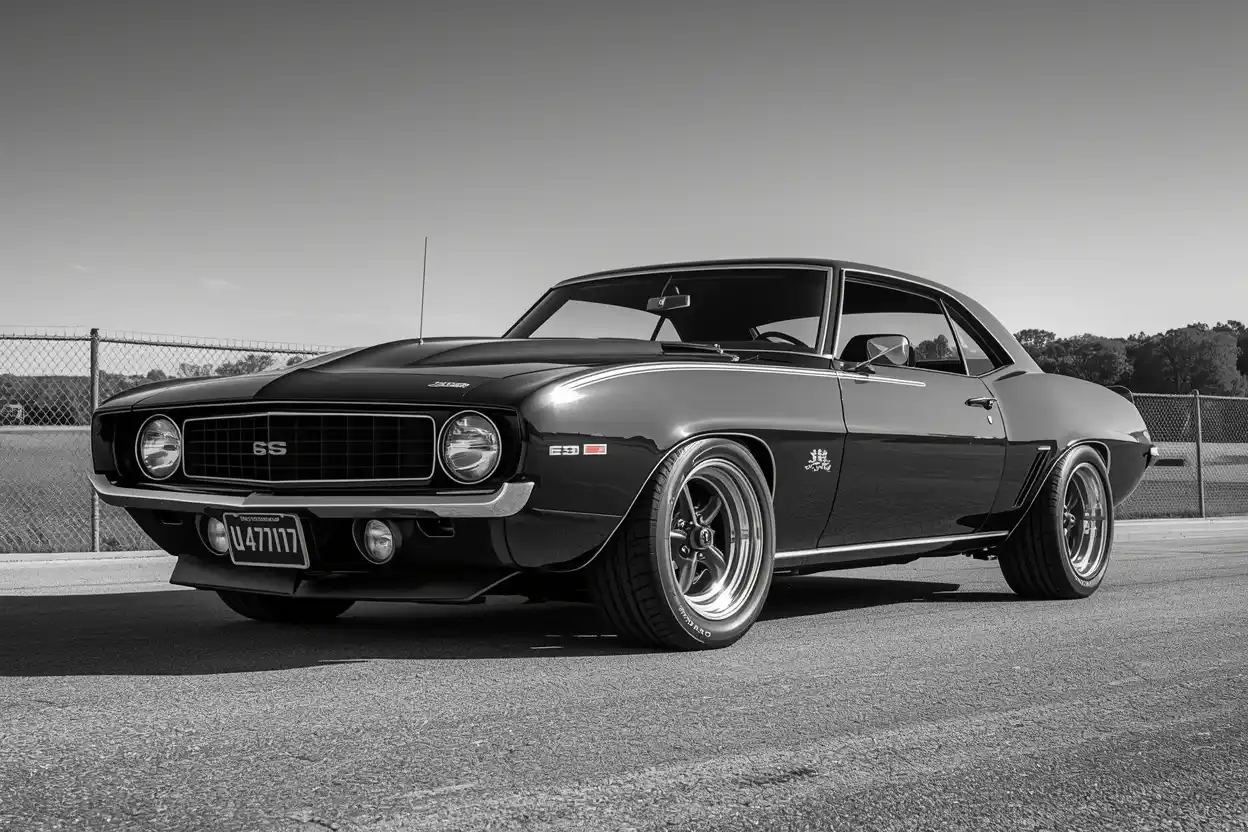
1969 was a pivotal year. Chevrolet gave the Camaro all-new sheet metal, making it look wider, lower, and more menacing. While the wheelbase remained at 108 inches, the technical evolution under the skin made it a formidable track and street machine. The "Super Sport" (SS) package was the performance heart of the line, offering heavy-duty suspension and massive torque.
1. The Heart: L35 Big Block 396 V8
While the 350 Small Block was the volume seller, the 396 cubic inch (6.5L) Turbo-Jet V8 turned the Camaro into a supercar slayer. This engine utilized "Porcupine" cylinder heads (named for their unique valve angles) which allowed for massive airflow, essential for generating high-RPM horsepower.
Technically, the 396 was a masterpiece of iron. It featured a high-lift camshaft and a massive Rochester Quadrajet carburetor. Managing the heat soak from such a large engine in a relatively small engine bay was one of Chevy’s biggest engineering hurdles, leading to the iconic "cowl induction" hood which sucked cold air from the base of the windshield.
⚙️ 1969 Camaro SS396 Technical Specs
- Engine Type: V8 L35 "Big Block"
- Displacement: 6,489 cc (396 cu in)
- Bore x Stroke: 4.09 x 3.76 inches
- Fueling: 4-Barrel Rochester Quadrajet
- Horsepower (Gross): 325 hp @ 4,800 rpm
- Torque: 410 lb-ft @ 3,200 rpm
- Compression Ratio: 10.25:1
OCTANE AND VALVE SEATS WARNING
The 1969 Big Block was designed for high-octane leaded gasoline. Modern unleaded fuel burns hotter and lacks the lubricating properties of lead. Without Hardened Valve Seats or a high-quality lead substitute additive, you risk "valve recession," which will eventually destroy your cylinder heads.
➡️ Protect Your Valves: Shop Lead Substitutes
2. Handling the Torque: F41 Suspension Geometry
A common myth is that muscle cars can't turn. The 1969 Camaro SS came standard with the F41 Heavy Duty Suspension. This included stiffer front springs, a thicker 11/16" front stabilizer bar, and—crucially—multi-leaf rear springs. Earlier Camaros suffered from severe "wheel hop" due to mono-leaf designs; the 1969 multi-leaf setup fixed this by increasing the spring rate and damping.
However, the factory steering ratio remained "slow" by modern standards. Many owners today swap the original steering box for a Quick-Ratio 12.7:1 box to give the car the modern, "darty" feel it deserves.
🛠️ Upgrade Your Steering: Shop Gear Boxes
3. Tires: The Radical Shift to Radials
In 1969, the Camaro SS wore D70-14 bias-belted tires. These were a slight improvement over standard bias-ply, but they were still prone to "tread squirm." Under the 410 lb-ft of torque from a 396, these tires would simply go up in smoke without providing any meaningful forward momentum.
The Modern Setup:
To make a '69 Camaro handle like a pro-touring machine, the tire choice is paramount. The goal is to maximize the contact patch without rubbing the inner fenders during full-lock turns.
- The Staggered Look: 235/60R15 Front | 255/60R15 Rear.
- Rim Selection: The classic 15x7 or 15x8 "Rally Wheels" are the period-correct choice.
- Modern Performance: For those running 17" or 18" wheels, a 245/40R18 front is the technical limit before hitting the subframe.
🛒 Shop High-Performance Classic Tires
4. Braking: The Achilles Heel
Stopping 3,500 lbs of iron with 1960s technology is an exercise in bravery. While the SS package often included power-assisted front discs, the rear remained drum-based. The proportioning valve in these cars was notoriously finicky, often sending too much pressure to the rear, causing the back end to "wash out" under heavy braking.
A technical necessity for any driven Camaro is a Dual-Bore Master Cylinder. Original single-reservoir systems are dangerous; if one brake line leaks, you lose all four brakes. A dual-reservoir ensures that even with a leak, you keep 50% of your stopping power.
🛑 Braking Efficiency Comparison
| Setup |
Stopping Distance (60-0) |
| Factory 4-Wheel Drums |
255+ ft |
| Factory Disc/Drum Mix |
210 ft |
| Modern 4-Wheel Disc + Radials |
135 ft |
🔥 Shop Brake Safety Upgrades
5. Conclusion: The Engineer's Perspective
The 1969 Camaro is more than just a pretty face; it is a highly tunable platform. From a technical standpoint, its strength lies in its modular subframe design. By unbolting the front subframe, owners can swap in modern independent suspension, rack-and-pinion steering, and fuel-injected LS engines.
But for the purist, the magic is in the mechanical struggle. Balancing the carburetor, feeling the "kick" of the 4-speed Muncie transmission, and managing the live-axle skip on a backroad is what makes the 1969 Camaro an immortal icon of American engineering.
Planning a restoration? Read our guide on upgrades and authenticity:
Read: 1969 Camaro SS: Engineering, Authenticity & Modern Upgrades